
We put an AI inside a Game Boy Advance
DrawIt is a game for a handheld console from 2001 in which you doodle with the arrow buttons and the console guesses what you are drawing. The guessing is done by a small AI that lives entirely inside the game: no internet, no server, nothing but the console's own 16.78 MHz processor.
- Words in the game
- 330
- Right on the easy words
- about 7 in 10
- Time to answer
- under half a second
- Size of the AI
- about 200 KB
The game
The game gives you a word, such as HOUSE or LADDER, and a blank grid of 28 by 28 squares. You move a cursor with the arrow buttons and hold A to paint. A second tool draws straight lines between two points, because diagonals are miserable on arrow buttons.
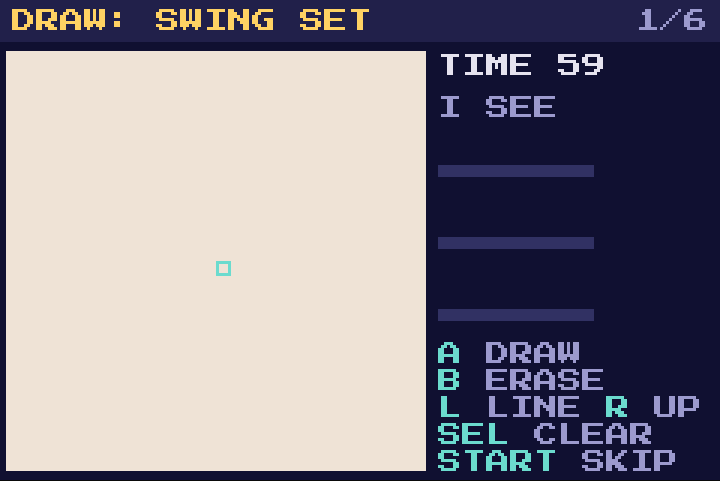 A round begins: a word, a blank grid and the clock.
While you draw, the right side of the screen shows the console’s three best guesses, each with a percentage. As soon as its top guess is your word, you win the round. A game is six words.
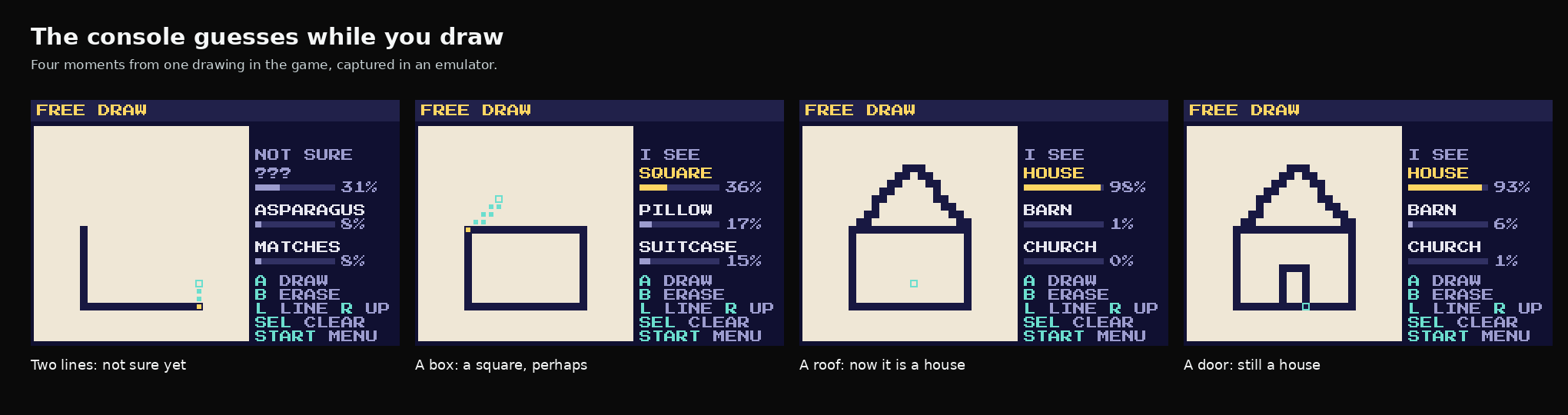
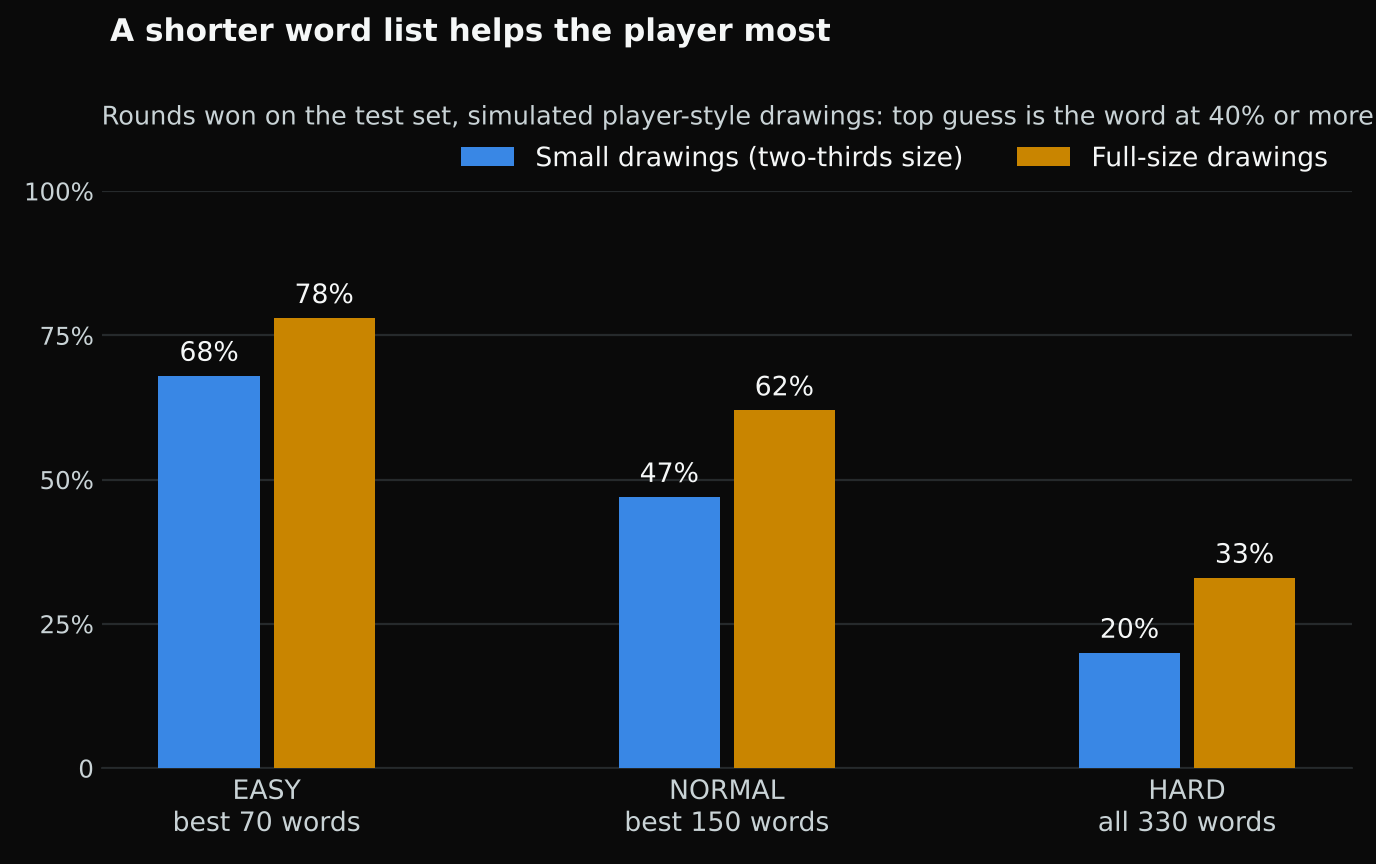
There are three word lists. EASY has the 70 things the AI recognises most reliably and gives you 60 seconds. NORMAL has 150 and HARD has all 330; both give you 99. In a round only the words on your list compete as answers, so the shorter the list, the surer the guesses. A third mode has no word and no clock: you draw whatever you like and watch it guess among all 330.
When it has too little to go on, it says so. One short line gets the answer “not sure”, not a confident wrong guess. A single dot gets no answer at all.
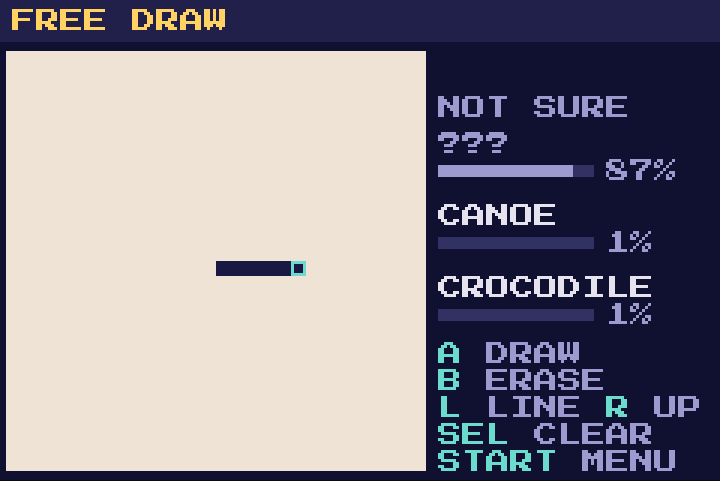 One short line is not enough to go on, and it says so.
The model
The AI is a list of about 200,000 numbers and a fixed recipe for multiplying and adding with them. Nobody wrote rules like “a house has a triangle on a square”. The numbers were found by showing the recipe a great many drawings and correcting it each time it was wrong.
Each guess follows the same steps:
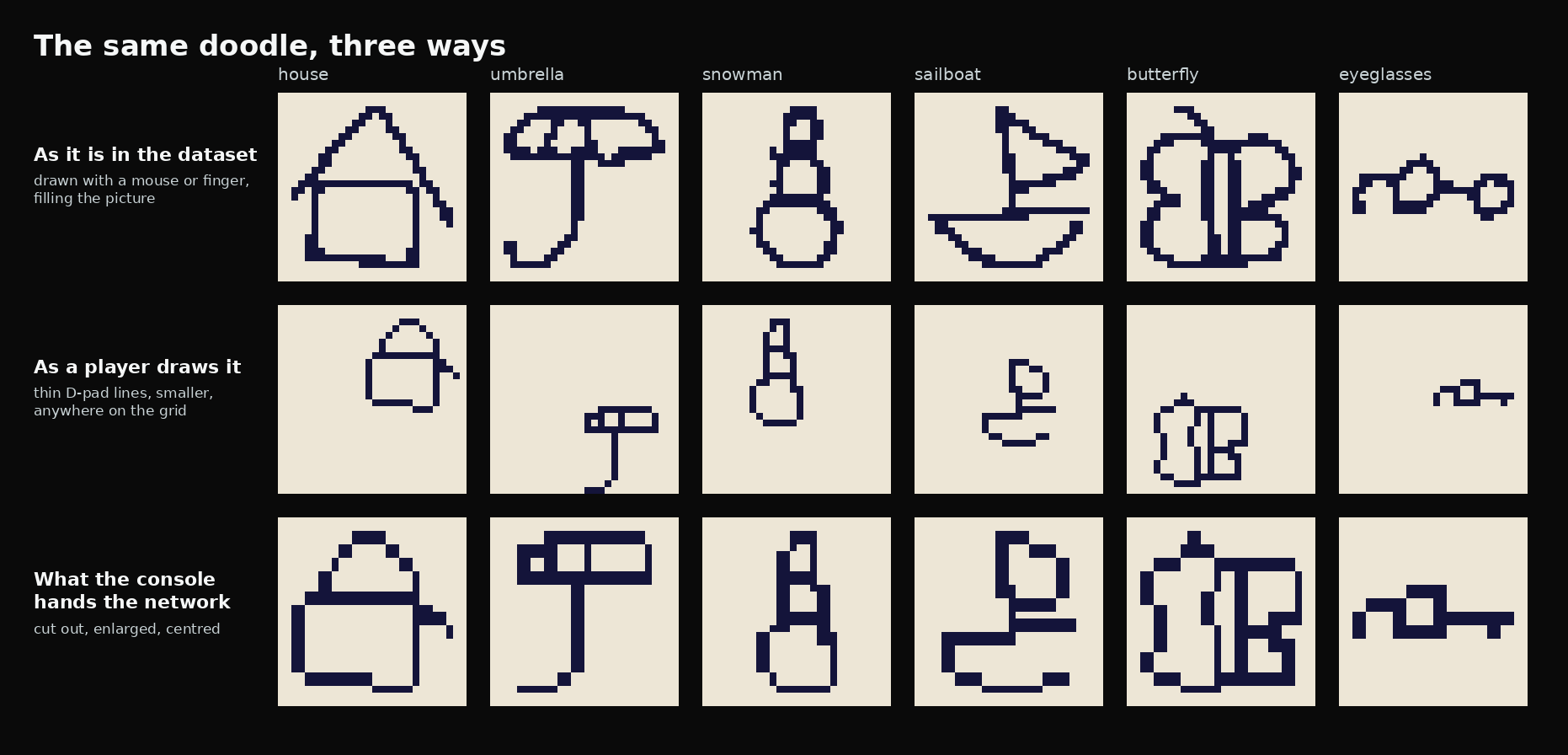
- Tidy up. The drawing is cut out, enlarged to fill the grid and centred, so a small house in the corner looks the same as a big one in the middle.
- Look for strokes. Sixteen tiny stencils slide over the picture. Each reacts to its own small pattern of ink and empty squares.
- Combine strokes into shapes. Forty-eight detectors look at which strokes sit next to each other.
- Note what is where. The result is boiled down to 256 clues about the whole picture.
- Vote. Each possible answer, plus “not sure”, weighs the clues and gives itself a score. The three highest are shown.
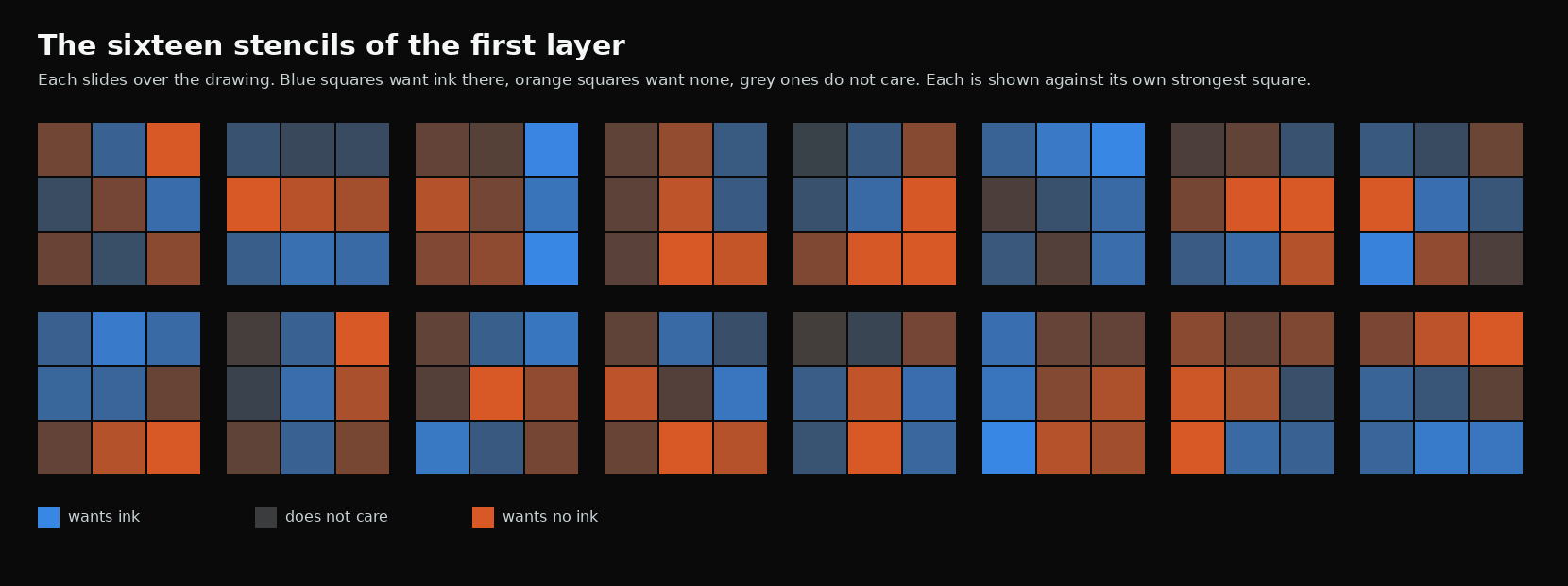
The percentages are tuned against drawings held back from training so that, on average, the console is as confident as it is correct.
How it learned
The drawings come from Quick, Draw!, a public collection of doodles that people around the world made for a Google experiment. We used 6,000 drawings for each thing, about two million in total, and kept two more sets of 1,000 of each aside: one to tune the game on, and one looked at only once, at the very end, for the numbers on this page.
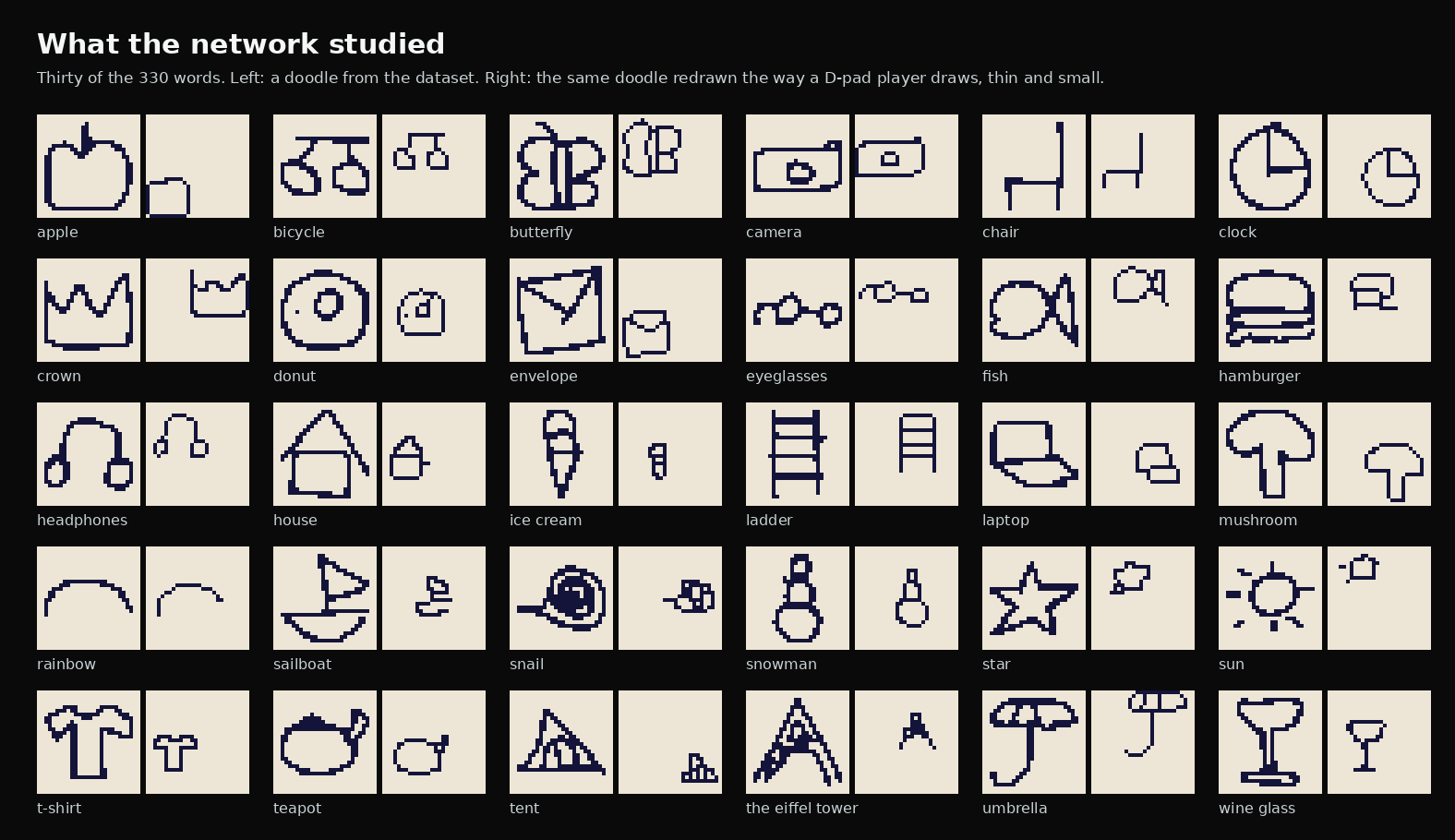
Training took about 33 minutes on a single graphics card in the cloud. The model saw every drawing twenty-four times. Each time it guessed wrong, its numbers were nudged slightly towards the right answer.
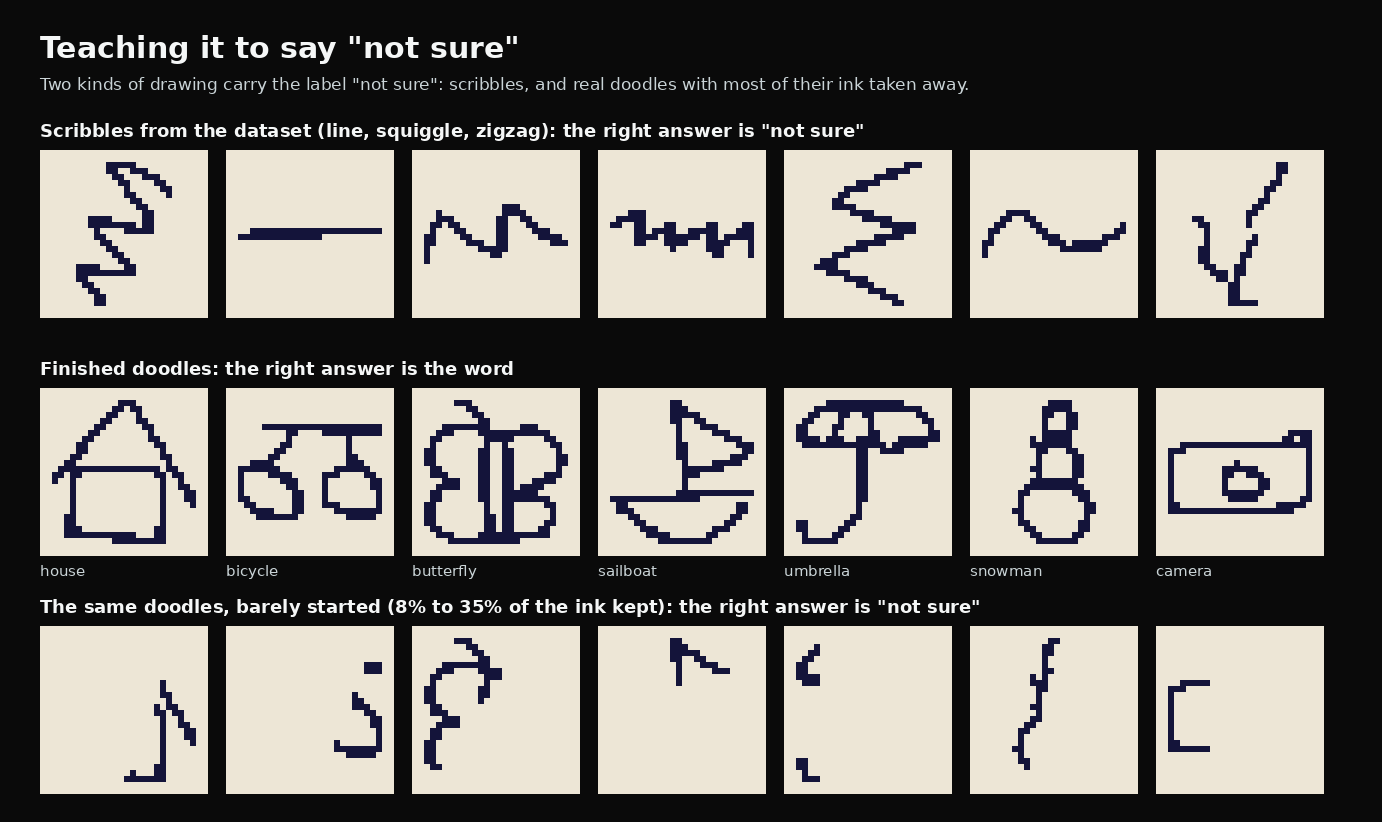
“Not sure” was taught as an answer of its own, from scribbles and from real drawings with most of their ink removed.
What we got wrong first
The first version with 330 words passed every test we wrote and was close to unplayable. Our test drawings filled the whole grid, as the training drawings do. A person with arrow buttons draws small, thin and off to one side.
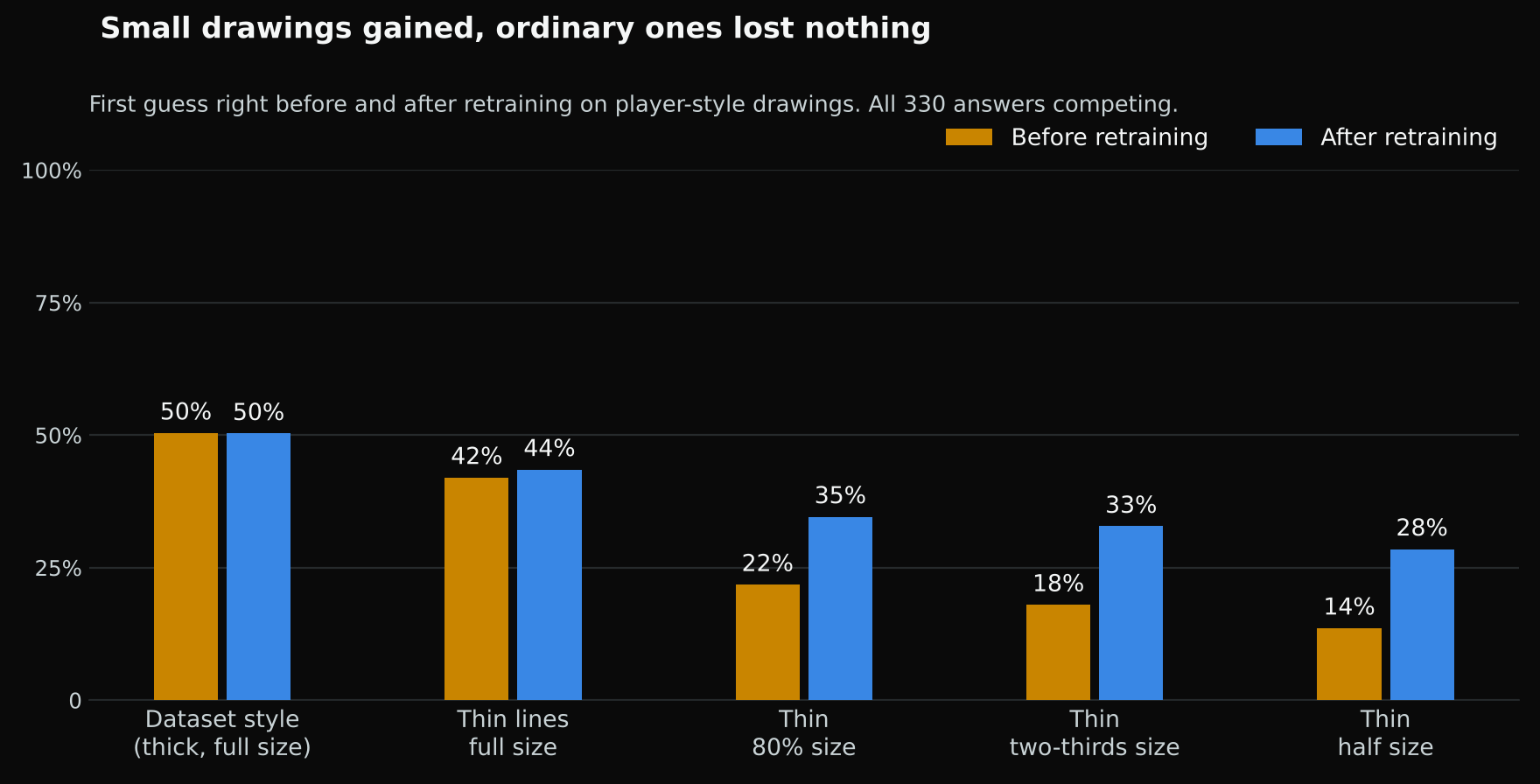
On drawings two-thirds the usual size, the model’s first guess was right about 1 time in 30. It had never seen a small drawing, so it did not recognise one.
Two changes fixed it. The console now tidies every drawing before looking at it, which is step 1 above. And the model was trained again with most of its drawings redrawn the way a player draws: thin lines, smaller, anywhere on the grid. On the same small drawings its first guess is now right about 1 time in 3 across all 330 words, and in the game it wins about 2 rounds in 3 on the easy list. HARD is hard for the console too: with every word in play it wins roughly 1 round in 5 on small drawings.
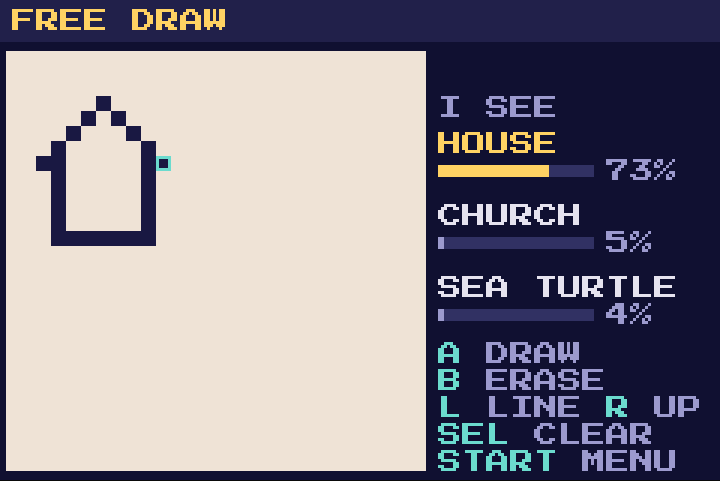 A small house up in one corner, read as a house.
Making it fit
The console has a 16.78 MHz processor, 288 KB of working memory, and no ability to do arithmetic with decimals. The model was trained on a modern machine with none of those limits, then squeezed.
- One byte per number. Each of the 200,000 numbers is stored as a whole number between -127 and 127. The AI takes about 200 KB; the whole game is about 240 KB, smaller than one phone photo.
- Whole-number arithmetic only. Every step was rewritten to avoid decimals. The squeezed version picks the same answer as the original on 97.7% of 4,000 test drawings.
- A shortcut for the first step. A square is either inked or empty, so the first layer needs no multiplication at all, only addition.
- Thinking between frames. A guess takes about half a million multiply-and-adds, because the stencils are reused at every position of the picture. The console does them in small slices in the idle moments of each screen refresh, so the cursor never stutters while it thinks.
Beyond the game
Nobody needs a doodle game on a 25-year-old console. The point is the constraint. If a model that tells hundreds of everyday things apart from a rough sketch runs on this hardware, the same kind of model runs on the small, cheap chips already inside appliances, tools, toys and sensors.
If it fits in a game cartridge from 2001, it fits in your device.
Recognising a doodle is close kin to recognising a gesture on a touchpad, a handwritten digit on a form, or a symbol on a label. Done on the device itself, that works with no connection, answers at once, and sends nothing anywhere.
That is what Miraku does: we compact and fit AI models inside devices offline, no cloud needed.
What we have not shown
The accuracy figures come from test drawings altered by a program to look like a player’s, not from many people playing. On all 330 words with full-size drawings from the original collection, the first guess is right half the time and the right answer is in the top three 7 times in 10. Some things it rarely gets: a dog, a bird and a frog look alike at this size.
Credits
- Drawings: Quick, Draw! dataset by Google, licensed CC BY 4.0.
- Lettering in the game: Press Start 2P, licensed under the SIL Open Font License.
Game Boy Advance is a trademark of Nintendo. Miraku is not affiliated with Nintendo.